Disclosure: The Juice Index is reader-supported. If you buy through links on this page, we may earn a commission at no extra cost to you.
A dc fast charger at home isn’t a realistic purchase for almost any residential property. The hardware needs three-phase 480V commercial power. Most US homes have single-phase 240V service with a 100A or 200A main panel.
That gap is a supply problem. A 50 kW DC charger draws roughly 60 to 80 amps at 480V three-phase, per AutoEdgeView. A 150 kW unit needs about 375A at the same voltage, per Charge Rigs.
Here’s what DC fast charging actually is, what it takes to run it, and which home setup gets you the fastest charging instead. I’ll also cover the mistakes I see readers make when they price this out.
Can You Actually Get a DC Fast Charger at Home?
No, not practically. A true DC fast charger needs three-phase 480V commercial power that virtually no US home has, according to AutoEdgeView. That’s a different class of electrical service. A bigger breaker won’t get you there.
It’s technically possible if your property already has commercial-grade three-phase service. That’s extremely rare in residential settings. Equipment alone for a 50 kW DC fast charger runs into tens of thousands before any utility work, per AutoEdgeView, and it still needs three-phase 480V power.
When people search for a dc fast charger at home, they usually mean the fastest home EV charger. That’s a different product. The realistic home equivalent is a 48A Level 2 charger on a 240V circuit. According to Charge Rigs, a 48A Level 2 charger adds 30 to 40 miles of range per hour and fully charges most EVs overnight. AutoEdgeView puts a 48A charger on a 48-amp circuit at 11.5 kW, adding roughly 40 to 45 miles of range per hour.
So the practical ceiling for home charging is a 48A Level 2 unit on a dedicated 240V circuit. If your panel can’t support that, the answer isn’t a DC charger. Call an electrician and get a load calculation.
For sizing that circuit, see 32 Amp EV Chargers: Speed, Wiring and Picks and 240 Volt EV Chargers and Charging Stations.
How DC Fast Charging Works vs. What Your Home Can Deliver
A DC fast charger skips your car’s onboard charger entirely. It feeds DC power straight to the battery at 50 kW to 350+ kW, per AutoEdgeView (F117, F97). Your home can’t do that.
Home power is single-phase 240V AC, the same supply your dryer or oven uses. Level 2 charging through that service maxes out at 19.2 kW (F1, F230).
The gap is infrastructure, not amperage
A 50 kW DC charger draws roughly 125A at 480V three-phase, per Charge Rigs (F76). A 350 kW unit needs nearly 1,000A at 480V three-phase (F78). Most homes run 100 to 200A of single-phase service.
A bigger breaker won’t close this gap. Three-phase 480V is a different class of electrical infrastructure. A residential panel upgrade doesn’t deliver it.
DC charging ranges from as low as 11kW to upwards of 400kW (F181). Even the lowest end needs three-phase power. RAC WA notes this is common in businesses but less so in residential houses (F200).
If your property already has commercial-grade three-phase service, a DC unit may be technically possible. For everyone else, the honest answer is no. I would stop shopping for DC hardware and size a Level 2 circuit instead.
Home Charging Numbers: What You Can Actually Install
Level 1: The Outlet You Already Have
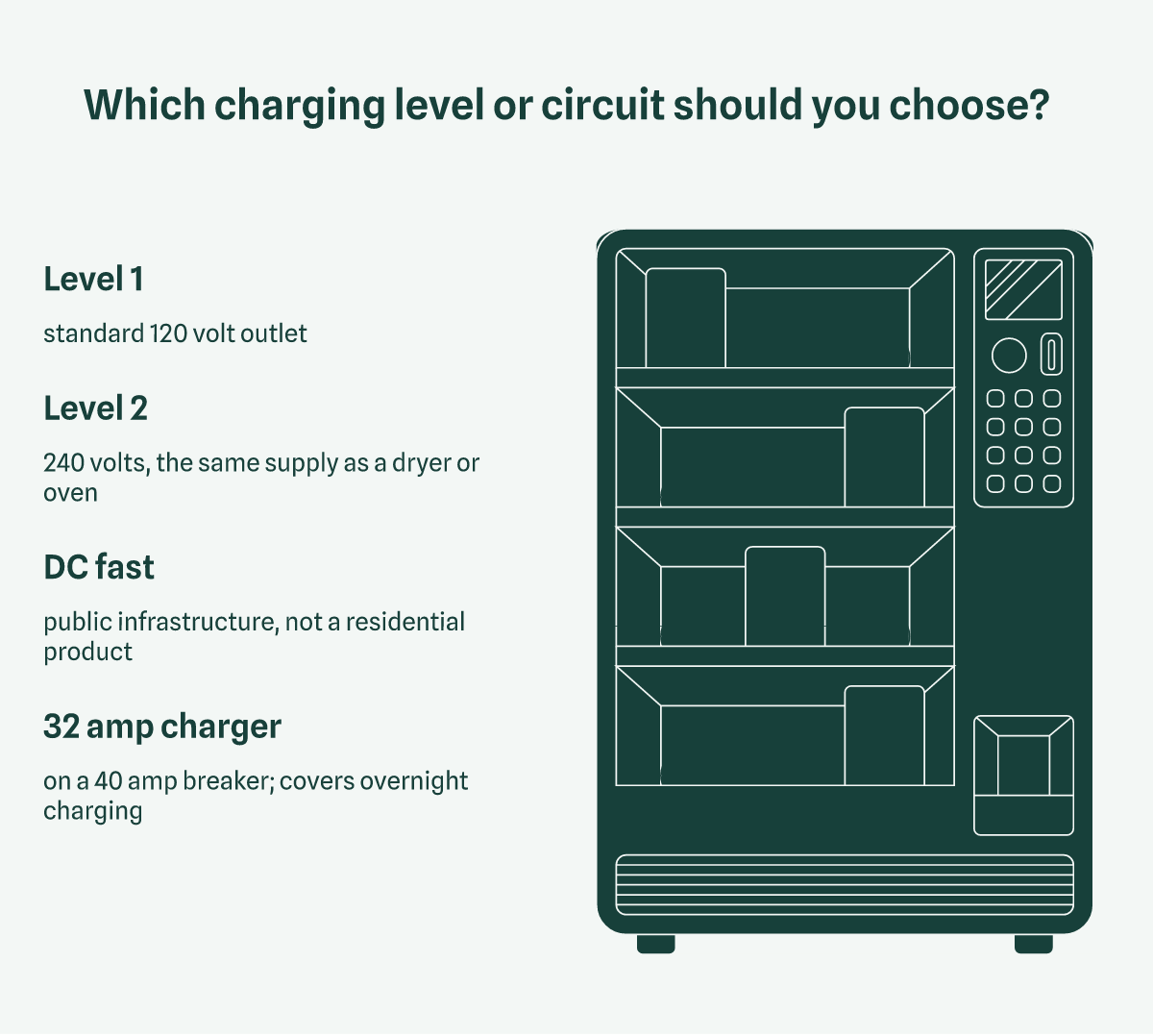
Level 1 runs on a standard 120 volt outlet. That covers a short commute and little else.
Level 2: What Almost Every Home Should Install
Level 2 runs on 240 volts, the same supply as a dryer or oven, and adds 10 to 20 miles per hour at typical amperage (F31). At maximum it reaches 19.2 kW, and the US Department of Transportation says Level 2 can charge a battery electric vehicle from empty in 4 to 10 hours (F1, F233). A 48 amp Level 2 charger adds 30 to 40 miles of range per hour and fully charges most EVs overnight (F87). A Level 2 home charger at 11.5 kW can fully replenish a 75 kWh battery in roughly 7 hours (F99).
| Level | Supply | Range added per hour |
|---|---|---|
| Level 1 | 120V AC | 2 to 5 miles |
| Level 2 | 240V AC | 10 to 20 miles |
| DC fast (public) | 480V three-phase | 120 to 240 miles |
DC fast charging adds 120 to 240 miles per hour and charges a BEV to 80 percent in under an hour (F57, F234). It’s public infrastructure, not a residential product.
If your panel can’t take a 48 amp circuit, don’t force it. A 32 amp charger on a 40 amp breaker covers overnight charging for most drivers. I would rather see a smaller circuit done properly than a service upgrade you didn’t need.
What a Home DC Fast Charger Would Actually Cost
The equipment is the first wall. Nothing in that price range is built for a driveway.
Then the electrical work starts.
And that is before you run it.
Set that against the alternative. You wake up with a full battery. For me the cheaper fix is enough, and I would stop reading quotes the moment a contractor mentions three-phase service. That goes against the reflex to chase the fastest possible charger, but the numbers don’t support the chase.
One offset exists. Eligibility depends on your census tract meeting specific requirements, so check that before you count on it.
Common Mistakes and Misunderstandings About Home DC Charging
Thinking a Level 3 charger is just a faster Level 2
It’s not. A Level 2 unit takes 240V AC and tops out at 19.2 kW, per the EPRI Consumer Guide to Electric Vehicle Charging. A DC fast charger feeds the battery directly and starts at 50 kW. The gap isn’t a bigger breaker. It’s a different supply class.
Chasing speed you don’t need
About 75% of EV charging happens at home, per the EPRI guide. Public locations account for 20% and work covers the last 5%. A 48A Level 2 charger adds 30 to 40 miles of range per hour, according to Charge Rigs, which handles most overnight charging. I’d ignore the “fastest home EV charger” framing. Common advice tells you to buy the highest amp rating you can afford. My view: the fastest home charger is the one your panel can actually feed, and that’s usually a 32 amp unit.
Assuming an upgrade gets you there
A panel swap doesn’t bridge the gap. A 50 kW charger needs roughly 125A at 480V three-phase, per Charge Rigs. The AutoEdgeView guide notes that a 50 kW DC fast charger requires three-phase 480V commercial power, “something virtually no US home has.” If your property already has commercial three-phase service, get a load study before anything else. Otherwise, spend on a 240 volt Level 2 setup and keep DC fast charging for the road.
FAQ
Any DC Fast chargers for the house?
No consumer DC fast charger exists for a house. The hardware is commercial equipment, sized for three-phase 480V service. Charge Rigs lists a 50 kW charger as needing approximately 125A at 480V three-phase power, and a 350 kW unit at nearly 1,000A at 480V three-phase. AutoEdgeView states plainly that a 50 kW DC fast charger requires three-phase 480V commercial power, “something virtually no US home has.” The Consumer Guide to Electric Vehicle Charging marks DC fast charging “Not applicable for home charging” in its use case row. I would treat any listing that claims otherwise as commercial gear with a residential label.
Can I have a DC EV charger at home?
Technically yes, practically no. Nothing in the electrical code forbids it, but your service almost certainly can’t feed it. Most homes run single-phase 240V. AutoEdgeView describes the upgrade path as utility transformer replacement or addition, a new service drop and metering, complete panel replacement to 400A or more, and commercial-grade conduit and wiring. Charge Rigs puts the utility upgrade alone in the tens of thousands and up. If this were my call, I wouldn’t chase it. The common advice that a DC charger is the ultimate home upgrade gets the tradeoff backwards. You spend a fortune to charge overnight anyway.
Is DC charging possible at home?
A commercial site can be built where a house stands. That’s the only sense in which home DC fast charging works. You can get DC charging at home if the property has three-phase 480V service and you’re willing to pay for commercial equipment. The IAEI Magazine notes DC fast charging equipment typically takes a three-phase AC input and runs at power outputs up to 500 kW. RAC WA puts DC charging anywhere from 11kW to upwards of 400kW. That 11kW end is the interesting one, though it still needs three-phase power. RAC WA calls that common in businesses and less so in residential houses. For a normal single-phase home, the honest answer is no.
How much does a home DC fast charger cost?
Far more than any home charging setup justifies. I would put that difference toward a second EV.
How to get dc fast charging at home?
You don’t, and you don’t need to. The practical route is a Level 2 charger on a 240V circuit, which covers the same daily goal. Charge Rigs notes a 48A Level 2 charger adds 30-40 miles of range per hour and fully charges most EVs overnight. AutoEdgeView puts a 48-amp circuit at 11.5 kW adding roughly 40-45 miles per hour. Start with your panel capacity, then size the circuit. If you want the wiring detail, see 32 Amp EV Chargers: Speed, Wiring and Picks and 240 Volt EV Chargers and Charging Stations. For two cars, Dual EV Chargers for Two-EV Homes covers sharing one circuit.
Sources
- Consumer Guide to Electric Vehicle Charging
- Can You Install a DC Fast Charger at Home? Requirements, Costs, and Alternatives | Charge Rigs
- Level 3 Charger at Home: Is DC Fast Charging Possible for Residential Use? | AutoEdgeView
- How To Charge An Electric Car At Home | RAC WA
- Charger Types and Speeds | US Department of Transportation
- Electric Vehicle Charging Infrastructure: Stations, Equipment, and Planning – IAEI Magazine
- DC Fast Charge at Home: Is It Worth It? Costs, Equipment & Reality | AutoEdgeView
- What Is DC Fast Charging?