Disclosure: The Juice Index is reader-supported. If you buy through links on this page, we may earn a commission at no extra cost to you.
Yes, you can get an ev dual charger. For most two-EV homes, though, I’d point you to a pair of power-sharing units on one circuit instead of a single box with two cables. Here’s why that matters. A dual-port unit splits its total output, so a 7.4 kW charger gives each car about 3.7 kW when both plug in at once.
I cover the specs that actually decide this. I also get into how the price tiers differ, which setup suits which household, and the options I would skip. Weighing a single dual-port charger against two load-balanced chargers? The sections below run the numbers on both.
What Actually Matters: The 3–5 Specs That Decide a Dual EV Charger
Total output vs. Per-car output
This is the number that trips people up. A dual-socket charger splits its total output between two vehicles, often 3.7 kW each when both are charging at once from a 7.4 kW unit (bestchargers.co.uk). Plug in only one car and it gets the full 7.4 kW (bestchargers.co.uk). The same logic scales. The two most common dual EV chargers are 7.4kW and 22kW, which will provide 3.7kW to each vehicle, or 11kW to each vehicle, respectively (evinfrastructurenews.com). Read the spec as two numbers, not one.
Circuit capacity
Two load-balanced chargers can share a single 32 A circuit, dynamically splitting available power between them (bestchargers.co.uk). Two independent 32 A circuits give each car full-speed charging at the same time, but they require greater electrical capacity and higher installation cost (bestchargers.co.uk). Decide this before you shop. The circuit decides what the hardware can do.
Power-sharing vs. Sequential vs. Split
Dynamic sharing means one car gets full power and two cars split it (evchargerlab.com). A splitter takes turns automatically, and on a 50A outlet, both can also charge at 20A each (getneocharge.com). Sequential is slower, and it reuses wiring you already have.
Hardwired vs. Plug-in, and cord length
Long cords matter if the cars park apart. Plug-in matters if you rent.
Onboard charger limits
The Hyundai Kona Electric has an 11 kW AC charger (bestchargers.co.uk). So do the Audi Q4 e-tron and the VW ID.3 non-Pure (bestchargers.co.uk). The ID.3 Pure has 7.2 kW (bestchargers.co.uk). A 22 kW unit may be wasted on any of them. Check each car’s onboard limit before paying for headroom neither car can use. Most buyers skip this step.
Spec Table Across Price Tiers
I’m listing prices because the sources list them. Read them as tier markers, not quotes.
Budget tier
The NeoCharge Smart Splitter is the no-new-circuit route. It splits one existing 240V outlet between two chargers, so there’s no wiring run (F108). On a 50A outlet, both cars can also charge at 20A each. Otherwise it takes turns automatically (F140). My pick for renters and anyone with zero panel headroom. The catch is sequential charging, so one car waits.
Single dual-port unit
The Grizzl-E Duo is one box with two 24-foot cords (F1). It puts 40A shared across a 50A circuit, which is 2×24A when both cars draw (F87). You can’t hardwire it. That shared 40A also makes it slower than the pairs below (F2).
Power-sharing pair
The Wallbox Pulsar Plus 48 pair is the tier most two-EV homes land in. Two units share one 60A circuit and split power dynamically, so a solo car gets the full 48A (F71). It’s hardwire-only at 48A, and you buy two units (F72).
What the other pairs buy you
The Tesla Universal Wall Connector shares power across up to six units. That matters in mixed NACS and J1772 garages (F111). The Emporia pair is the value option. The Autel pair adds smart load management.
UK reference
If you have panels, that gap buys scheduling. It doesn’t buy speed.
Picks by Use Case
Two average commutes, one panel, no upgrade
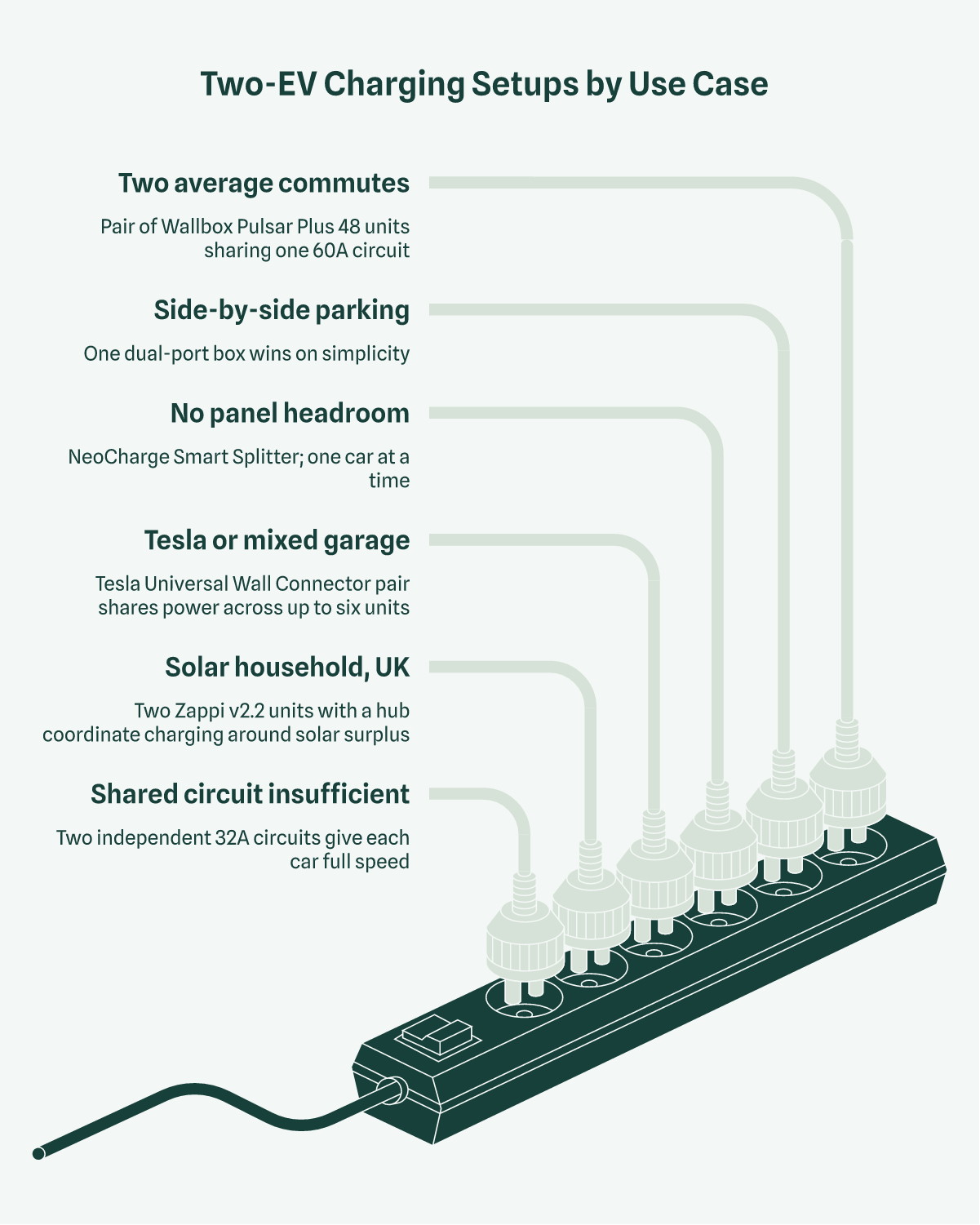
My pick is a pair of Wallbox Pulsar Plus 48 units sharing one 60A circuit. One car gets the full 48A. Two cars split it dynamically.
On that shared 60A circuit, evchargerlab reports about 5.75 kW per car when both charge at once. That’s roughly 15 to 20 miles of range per hour per car. Two normal commutes? Covered overnight.
Two cars parked side by side, simplest install
One dual-port box wins on simplicity. United Chargers’ Grizzl-E Duo has two 24-foot cords. Wirecutter notes it can’t be hardwired and splits 40A between two vehicles, so it charges slower than their other picks.
If the bays sit together and neither car needs a full battery every morning, take the split. The NeoCharge guide lists dual-port units for exactly this layout, two cars parked side by side.
Renters, no panel headroom, or an existing dryer outlet
Use a NeoCharge Smart Splitter. It splits one existing 240V outlet between two chargers with no new wiring. Charging is sequential, so one car at a time.
I think this is the most underrated option. Most two-car households drive under 100 miles a day, per NeoCharge, and a 50A circuit adds about 230 miles over an 8-hour night.
Tesla or mixed NACS/J1772 garage
A Tesla Universal Wall Connector pair shares power across up to six units, per evchargerlab. That handles a Tesla plus a J1772 car on one circuit.
Solar household, UK
Two Zappi v2.2 units with a hub coordinate charging around solar surplus. Best Chargers lists that pair for solar two-EV households.
When the shared circuit isn’t enough
Go genuinely parallel if both cars do 100+ miles a day, or one has a 77+ kWh battery needing the full overnight window. Two independent 32A circuits give each car full speed. Expect higher installation cost.
What to Skip
Skip the second circuit
A second circuit is the most oversold upgrade in two-EV homes. The arithmetic rarely justifies it.
A 50A circuit charging at 40A adds about 230 miles of range in an 8-hour night, per NeoCharge’s 2026 guide. That same source puts a typical two-car household at under 100 miles a day. If that describes your driveway, one circuit is already doing more than twice the work you ask of it.
Say each car needs a 10.5kWh top-up, which Heatable uses as its example. That’s 21kWh together. On a 50A circuit at 9.6 kW, that’s a little over two hours of charging. You have eight.
Even a 30A dryer circuit covers both cars if each gets a full night between them, again per NeoCharge. I would start there before calling an electrician about a service upgrade.
Skip the panel upgrade
That’s a lot of money to buy speed you may never use.
The exception is real, though. If both cars regularly drain significantly every day, or one car has a very large battery that needs the full overnight window, then genuinely parallel charging earns its cost. That’s how Best Chargers frames it.
For everyone else, my pick is a power-sharing pair on one shared circuit, or a splitter on the outlet you already own. Don’t pay for a second circuit just because two cars sit in the garage.
FAQ
Can you get A dual EV charger?
Yes. A dual EV charger is one box on one circuit with two charging cables, so both cars plug in at once. The Grizzl-E Duo Connect is a current example, and Wirecutter notes it has “two 24-foot cords.” The trade-off is speed. Wirecutter adds that it “can’t be hardwired, and it splits 40 A between two vehicles, so it charges slower than our other picks.” A 7.4 kW dual-socket unit splits to roughly 3.7 kW per car when both are charging, per bestchargers.co.uk. If this were my call, I would buy a dual-port box only when the cars sit side by side and neither needs a fast turnaround.
Which dual EV charger is best for A home?
For most two-EV homes I would pick a pair of power-sharing chargers over a single dual-port box. EV Charger Lab calls a pair of Wallbox Pulsar Plus 48 units sharing one 60A circuit the best overall two-EV setup, and notes two cars split the power while one car gets full output. That pairing costs more than one dual-port unit because you buy two. The upside is real. Each car keeps its own cable and its own bay. If you want one box and a simpler install, the Grizzl-E Duo is the value pick. If your panel has no headroom, the NeoCharge Smart Splitter reuses an existing 240V outlet instead.
Can you connect two EV chargers together?
Yes, if both units support power sharing. Two load-balanced chargers such as two Easee One units in cluster mode can share a single 32 A circuit and split the available power between them, according to bestchargers.co.uk. EV Charger Lab describes the same idea at higher output: two units share one 60A circuit, one car gets full power and two cars split it. Compatibility is the catch. The two chargers must be the same ecosystem or built to talk to each other. Mix brands and you usually get no sharing at all, which puts you back to needing a second circuit. Check this before you buy the second unit.
Are level 2 EV chargers worth it?
For a two-EV home, yes. A 50A circuit charging at 40A adds about 230 miles of range in an 8-hour night, per NeoCharge, while a typical two-car household drives under 100 miles a day. That single circuit covers both commutes. Even a 30A dryer circuit covers them if both cars get a full night between them, NeoCharge adds. Here is where I part with common advice: you don’t need two circuits or a panel upgrade just because you bought a second EV. The usual line is that each car needs its own dedicated circuit. For most households, one shared circuit and a scheduling habit is enough.
What’s the best EV charging setup for a two-EV household?
It depends on your overnight window and your panel. If both cars can take turns across a 6 to 8 hour window each, a standard single-phase 32 A circuit at 7.4 kW is sufficient to charge both EVs overnight, per bestchargers.co.uk. If both drivers need a full charge by morning, go parallel: two independent 32 A circuits each feeding its own 7.4 kW charger, which bestchargers.co.uk notes requires greater electrical capacity and higher installation cost. For a middle path, two power-sharing units on one 60A circuit deliver about 5.75 kW each when both cars charge at once, roughly 15 to 20 miles of range per hour per car, according to EV Charger Lab.
Sources
- The 6 Best Electric Vehicle Chargers for Home of 2026 | Reviews by Wirecutter
- Dual EV charger guide: best dual port EV charging stations
- Best Dual-Socket Home EV Chargers UK (Two-Car Households)
- Best Dual EV Charger 2026: Power-Sharing Picks for Two-EV Garages
- Your guide to dual electric vehicle chargers. - E.ON Next
- Can You Have Two EV Chargers at Home? Options for Two-Car Households
- How to Charge Two EVs at Home on One 240V Outlet (2026 Guide)
- Electric Vehicle Charging for Single-Family Homes | Building America Solution Center